Pulsars, the Space Beacons


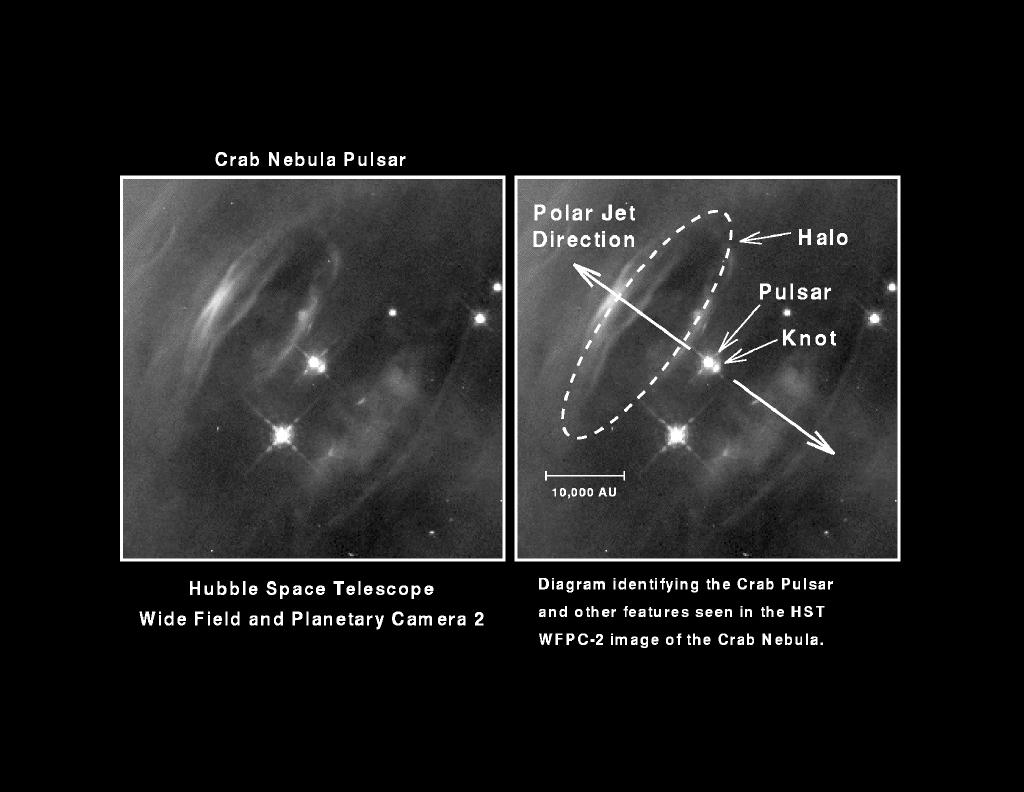
When a supernova explodes, most of the star is destroyed. However, the stars nucleus can survive the explosion. What remains after the explosion is so compressed that it is like an enormous nucleus of an atom. It is called a neutron star, since it is primarily made up of neutrons. A teaspoon of this matter would weigh more than a million tons. A neutron star has about the same amount of matter as the sun, but its diameter measures only about 6miles (10kilometers).
Neutron star does not give off visible light, but they transmit radio waves (another form of electromagnetic radiation, on a wavelength much longer than light). These tars spin very fast on their own, emitting a beam of radiation that spins along with the star, exactly as a light house’s lamp does. Each time the beam points towards the earth, we receive a pulse of radiation. This is what is known as a pulsar.
Pulsars were first discovered by chance in 1967by two British radio astronomers. At that time the existence of neutron stars was only a theory. Today we know of hundreds of pulsars in our galaxy, and every year more are discovered. Astronomers hope one day to discover the pulsar that was probably formed after the 1987 supernova explosion in the great Magellanic Cloud. The pulsations from pulsars are normally repeated in periods of less than a second. As a pulsar ages, its speed of rotation slows and the pulsations become less frequent. The youngest known pulsar is the center of the Crab Nebula, which is all that remains of the star that exploded in 1054.The Crab’s pulsar, has a period of 0.033 second, which means that the neutron star rotates 30 times per second. Recently faster pulsars have been discovered, which reach speeds of 500 rotations per second.
Posted by Swathi Mudunuru
|


0 comments:
Post a Comment